Appearance
Release notes - March 2, 2026
Auto Increase Parameter for Sync Integrations
A new Auto Increase option is now available for parameters within sync integrations.

When enabled, the selected parameter will automatically increment as long as the integration continues to return data. A delay of 2 seconds is applied between each call.
For example, when enabling Auto Increase on a page parameter, the page number will automatically increment until no more data is returned. This ensures that all available data is retrieved during the sync process.
Use post parameters to build endpoint
This update introduces improvements and clarifications to how endpoint parameters are processed:
- Endpoints can now contain {variable} placeholders, which will be replaced by the corresponding configured parameter values.
- If a variable is defined in the endpoint but not configured in the parameters list, it will now be sent unchanged.
- Parameters that are configured but not included in the endpoint path will automatically be appended as query parameters (consistent with previous behavior).
- All parameter values are now always URL-encoded (for example, spaces are encoded as %20).
These changes provide more predictable and flexible endpoint configuration while maintaining backward compatibility.
Example
url
https://myurl.com/api/v2/{variable1}/invoices/{variable2}.json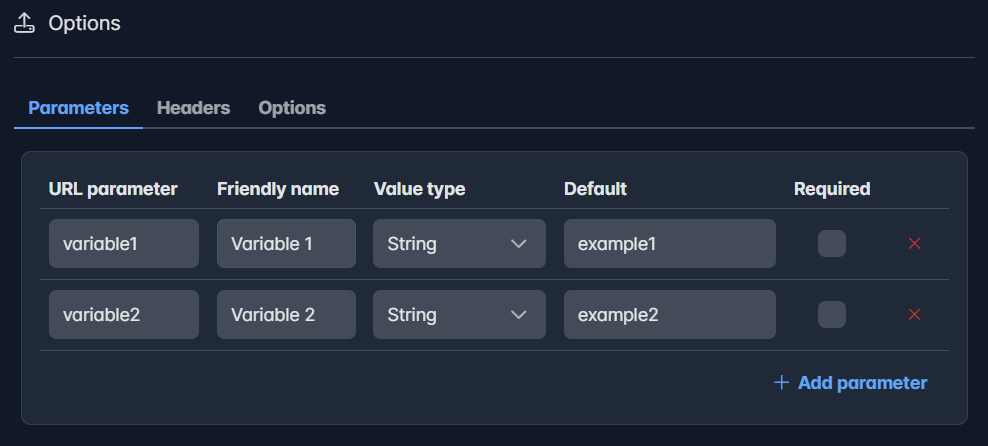
This will be executed as
url
https://myurl.com/api/v2/example1/invoices/example2.json{variable} placeholders in the endpoint can also be used to construct query strings.
url
https://myurl.com/api/v2/{variable1}?id={variable2}This will be executed as
url
https://myurl.com/api/v2/example1?id=example2Fixes
- Prevent Overwriting of Non-Imported Fields During Integration. When executing an integration, fields that are not included in the import will no longer be overwritten. This ensures that existing data remains unchanged unless it is explicitly part of the integration mapping.